
Horror music theory made simple with X, Y and Z cells, 12-tone rows and polytonality
You don't need much theory for horror. Learn X, Y and Z cells, 12-tone rows, polytonality, key shifts and odd time signatures, with steps for your DAW.
By Richard Pryn ·
Right, do you need to know music theory to write horror music?
The short answer is no, you don’t.
But learning a few of these tools and being able to label them makes you a better composer, with more ways to write interesting music. So this isn’t a theory lesson. It’s a toolbox, and a lot of it is as simple as moving MIDI around.
Why atonal music sounds like horror
Atonal music has no tonal centre. There’s no home, no landing place for your ears. That’s why it’s played such a huge part in horror: it’s brilliant for feeling lost, confused, scared, or slightly off.
Go and listen to Arnold Schoenberg’s Five Orchestral Pieces, then Iannis Xenakis’s Metastaseis. As a trailer composer I hear Xenakis and go, mate, that’s amazing. It’s risers, isn’t it? Hello, risers. Massive, dense clusters, and they’re terrifying.
X, Y and Z cells: three four-note tools
These come from atonal music, and they’re all tetrachords, which is simply a group of four notes. Bernard Herrmann used this kind of harmony all the time in his scores.
| Cell | Built from | Example on C | What it does |
|---|---|---|---|
| X cell | Four notes, each a semitone apart | C, C#, D, D# | Pure dread |
| Y cell | Four notes, each a whole tone apart | C, D, E, F# | An open question mark |
| Z cell | Semitone, perfect fourth, semitone | C, Db, Gb, G | Unresolved questioning |
The X cell
Four notes stacked a semitone apart. Play C, C#, D and D# together and you get the “someone’s just dropped dead and their head hit the piano” sound. It’s the musical equivalent of somebody’s shadow, or the weird face in the mirror.
It doesn’t have to be percussive. Spread the four notes across different octaves and put them on a solo cello or soft strings. Listen to how lost it sounds. Where am I?
You can also use an X cell and still stay in your key. In C minor, play a C minor chord, move to an F chord, then land on an X cell, and resolve to C minor 6 (C, Eb, G, A). For proper “everything’s gone wrong”, play a sweet major melody over the top of a held X cell. Whatever that nice music is, don’t listen to it.
The Y cell
Same idea, but the notes are a whole tone apart: C, D, E, F#. Those are the first four notes of C Lydian, the mode with the sharpened fourth. It doesn’t have the X cell’s grind. It’s lighter, a question mark rather than a scream.
But it can be dark. Just because the notes are a whole tone apart doesn’t mean it won’t sound dissonant. Put a Y cell on a pad and shift the whole chord upwards, and it gets nasty in the best way.
The Z cell
The Z cell isn’t equally spaced. It alternates a semitone and a perfect fourth: C up a semitone to Db, up a fourth to Gb, up a semitone to G. If you want a chord symbol for it, that’s C5(b9 #11), with the Gb spelled as F#. It’s built from two semitone rubs and two tritones, so it never settles.
Using the cells
- Horror hits. Have strings stab on the cell notes. When you land on the hit there’s no resolution, and that gives it an extra edge.
- Question marks. Y and Z cells are perfect for “I think he’s in the other room… no, he’s gone… is that him in the mirror?”
- Tense chord moves. Go from C minor to C minor add 9, then to an X cell, then to a Z cell.
If you want strings for those stabs, The Free Orchestra has string staccatos and brass clusters, and Albion Solstice has string and brass ensembles.
12-tone rows: a top line that goes nowhere
A 12-tone row is all 12 notes of the chromatic scale in an order you choose, with each note used once. You can start on any note. The only rule is that you tick off all 12 semitones without repeating any.
The classic ways to develop a row are retrograde (playing the row backwards) and inversion (flipping every interval upside down, so a step up becomes the same step down). A DAW’s mirror-pitch MIDI function does an inversion in one click.
Strict 12-tone writing makes my brain hurt, so I use rows as a feeling:
- Pencil in your 12 notes, no repeats.
- Chuck on a massive reverb. I used a 16-second tail.
- Halve the speed so the notes don’t come so often.
- Use it as a top line over a tremolo pad. It feels like it’s going somewhere without actually going anywhere.
- Duplicate the row a few times and move the copies into different octaves, some up, some down. Now each note becomes a chromatic chord moving in unison. That’s scary.
- Bounce it in place, reverse the audio, tuck it underneath and start pitch shifting it.
Polytonality: a shortcut to the freaky
Polytonality just means two or more keys at the same time. Play a C major scale, then lay a C minor scale on top. The loveliness of the major scale doesn’t sound nice anymore.
Not every pairing works. C major against A minor, its relative minor, uses the same notes (all the white keys), so you barely hear a clash. Pick keys that don’t share many notes. Try a G minor idea and stack a B minor or B major version on top. That’s when it goes “ring-a-ring-a-roses” wrong.
The weird thing is that it still sounds musical. And you don’t need to fully understand the keys:
- Pencil in a simple idea you like, even if you don’t know what it is.
- Copy the MIDI.
- Move the copy up a few semitones (I moved mine up three) and play both together.
- Put the copy on a different sound and add an echo.
Key fluctuations: make a tiny idea last a minute
I call this one multipolar tonality, or key fluctuations. Get the big words out of the way and it’s this: you briefly change key and then come back.
- Write a short, subtle idea in C minor with a little top line.
- Copy the whole thing and move it down a semitone into B minor.
- Paste the original back in after it.
- Do it again, but this time move the copy up a minor third.
You’ve just made your tiny idea last for a minute. You can also tweak a chord inside the shifted section. I added a C# against the C natural, and the horror vibe came straight back.
Unusual time signatures: something’s not quite right
Odd meters give you “something feels okay, but something is not quite right.” Think of John Carpenter’s Halloween theme, which is in 5/4, or Mike Oldfield’s Tubular Bells from The Exorcist, with its lopsided, shifting meter.
Mostly you’re thinking in fives and sevens. Group the eighth notes unevenly, like 3+2 for a bar of five and 3+2+2 for a bar of seven, and the downbeat keeps flipping on you.
- Set your project to 7/8 and lay down a steady pulse on sticks or piano.
- Write a simple piano or vibes pattern that follows the 3+2+2 grouping.
- After four bars of seven, insert a single bar of 5/8, then go back to 7/8.
- Drop in that odd bar for stops and sudden changes.
- Combine it with a key fluctuation: move the whole section up a tone.
In trailers they’re the horror equivalent of dramatic piano. Dad’s bought a new place in the woods, they get in the car, they pull up… and something isn’t quite right. It’s unsettling drama: a lighter shade of horror, but a very important one.
Wrap-up
None of this needs a theory degree. A four-note cell, a row of 12 notes, a copied MIDI region moved up three semitones or an extra beat in a bar will give you “something has gone wrong” fast. Learn the labels, then break the rules on purpose.
Happy composing! Rich
Tools mentioned in this guide

The Free Orchestra
A free Kontakt Player library of cinematic sounds drawn from ProjectSAM's catalogue, recorded in a concert hall: string staccatos, horns, brass clusters, choirs, percussion and drones.
Albion Solstice
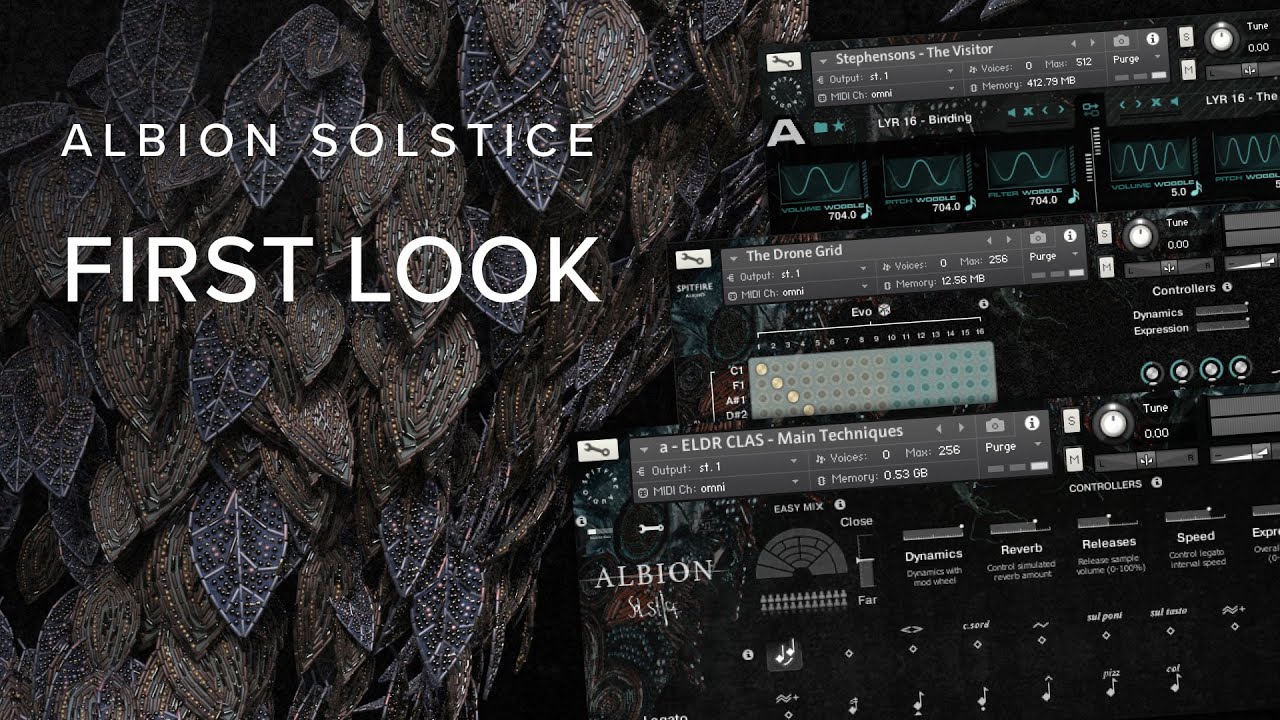
An orchestral library in three parts: The Solstice Orchestra (10 ensembles and a soloist, 235 articulations across strings, brass, woodwinds, choir, percussion, whistles, synths and guitars), The Cassette Orchestra (150 presets from 750 sources processed through tape, pedals and modular gear) and a Drone Grid of evolving textures.
Get the next guide by email
Get Richard's free horror sample pack, Flesh & Bow, by email.
Get the free sample pack →