
Organs, voices, toys and found sounds in horror music, and why they scare us
Why the organ, the human voice, toy instruments and found sounds make music sound like horror, and how to use each one to build your own horror arsenal.
By Richard Pryn ·
Okay, so what actually makes a piece of music sound like horror before a single dissonant chord has been played?
A lot of it is the instrument. The sound source carries baggage. Hear an organ and your brain has already gone somewhere. Hear a nursery rhyme in a dark house and you’re already uneasy. I could hand you a list of Kontakt instruments, but it’s far more useful to understand why certain sounds are scary, so you can blend them and make your own.
The horror arsenal
Here’s my list of staples. Some are obvious, because you’ll use them in nearly everything:
- Piano
- Strings
- Organs
- Synths. Budget cuts in the 70s and 80s made them vital for horror scores, and we still lean on them, whether for a single drone or a whole track.
- Reeds. I mean certain woodwinds here: bassoon, clarinet and oboe are brilliant for a more classical take on darkness and the macabre.
- Toys
- Found sounds
- Voice
- Spaces
Spaces is the odd one out, I know. But reverb and the sense of space in a track are so useful that I often treat them more like an instrument than an effect. You can argue with me on that. That’s fine.
For the record, the ones I reach for constantly, whatever library I’ve got loaded, are my voice, strings, piano, found sounds and spaces.
Let’s dig into the four that carry the most meaning.
The organ: death, churches and Transylvania
For centuries, the only place you’d find an organ was a church. That’s where we had weddings, mass and funerals, and outside the church there was the graveyard, with organ music drifting over the gravestones. I can’t be 100% sure, but I believe that’s where the link between organs and death comes from.
Then the link got deeper:
- Classical organ music became part of the playbook for dark scenes in silent films. Think Bach’s Toccata and Fugue in D minor.
- The Hammond organ turned up in radio plays, Hammer Horror, and low-budget TV and film. If you couldn’t afford string players or a band, you hired one organist. That cemented organs as the sound of ghosts and vampires.
An organ works like a bagpipe. Hear a bagpipe and you think Scotland. Hear an organ and you think, ooh, something otherworldly is about to commence. How otherworldly depends on how it’s played. It also has lighter associations (weddings, baptisms) so context matters.
The practical bit is choosing the right organ for the job:
- Pipe organ: regal, gothic, big churches, Transylvanian castles. Choose it when you want grandeur and ritual.
- Hammond and rock organs: this takes us back to 1950s and 60s horror and radio plays, that budget feel. I use Hammond pedal tones a lot in horror and thriller work. They’ve just got a great sound.
- The pipe organ’s flute stops: my favourite. They have an almost tubular-bells richness, wide and otherworldly. Hans Zimmer’s use of the organ in Interstellar cemented that feel.
Your choice of instrument changes how your whole track is perceived. Pick the organ that matches the era and the world.
The voice: the scariest instrument there is
I’ll cut straight to it. I polled my audience on social media, and I still think the voice is the scariest instrument.
Here’s why. The moment we hear a human voice, we’re drawn in. Film composers use this all the time: bring in a singer on the top line and suddenly everyone’s moved. In horror that same connection is used against you. You get the immediate connection and the immediate question: where is that coming from?
An organ playing in an empty building would be creepy, but part of you would think, “what’s that organ music?” Someone whispering in your ear as you walk down a dark corridor on your own, with nobody there? That’s full-on brown trousers time.
So think about how your own voice can go into your horror music:
- Drones. Record a long held note, layer a few, and let them blend.
- Breaths and whispers. Close, dry and right in the ear.
- Guttural noises. Groans and strange throat sounds, pitched down.
- Vocal percussion. Clicks, pops and hisses as a rhythm layer.
I use my voice all the time, because it’s unique. So is yours. If you’d rather start from recorded material, a whisper and spoken-voice library such as The Magic Whisper Collection gives you whispers and spirit voices from child, male, female and group performers to layer with your own.
Toys: the ghost child in the dark house
What’s so scary about children’s toys? Really it’s the question of what’s so scary about evil children. And the answer is juxtaposition.
Horror is about something you wouldn’t expect being there, being there. Children shouldn’t be in that dark house in the middle of the night, and that music shouldn’t be playing. Take something innocent out of its context and it becomes deeply creepy. That’s why it’s so much fun to sing a nursery rhyme over the top of a drone.
Anything that evokes childhood works:
- Toy instruments. Toy pianos and small tuned percussion. One of my favourites is a 1950s Pixie Phone I picked up at a car boot sale.
- A child’s voice. The ultimate one. If you can pay a child to sing in your track, great.
- Nursery rhymes, even played on a regular piano. It doesn’t have to be an out-of-tune toy piano.
- High-pitched voices in general.
Try this one. It takes two minutes:
- Record yourself singing a line of a nursery rhyme. “Ring a ring o’ roses” works.
- Transpose it up two octaves.
- Put it in a big gothic church reverb and turn it down a bit.
- Lay it over a drone, or under a simple piano progression.
It’s the Chipmunks gone bad, and it’s terrifying. Push it further with polytonality, putting the rhyme in a different key from what’s underneath, and it gets even more wrong.
Found sounds: the sound of the unseen
Found sounds are the sounds of the unseen, and that’s what makes them so spooky. Someone drops a can in the other room. Except nobody’s in the other room.
Yes, the Foley artist and sound designer add these to the film. But as composers we can use found sounds to enhance the score itself. Before you start, decide which way you’re using them, and why:
- For atmosphere. Slowly close a door, record the latch clicking, and drench it in reverb. It’s not Foley any more. It’s part of the music.
- For their sound qualities. Ripping and crunching paper as part of a percussion track, for example.
- A mixture of the two.
Found sounds work best as a sound design element rather than straight percussion, because they bring a sense of space and place. Record your own around the house first. If you need more, free archives like BBC Sound Effects and Freesound are good places to dig, but check the licence before anything goes in a commercial track.
Build your own arsenal
None of this is about loading a horror preset and hoping. It’s about knowing what each sound says to the listener: the organ says death and ritual, the voice says someone is here, toys say this shouldn’t be happening, and found sounds say there’s something in the next room. Collect your own versions of each, start blending them, and you’ll have a horror palette that sounds like you.
Happy composing! Rich
Tools mentioned in this guide
The Magic Whisper Collection
A whisper and spoken-voice library of about 980 sounds in 196 files (24-bit/96 kHz, 5.72 GB), split into raw, stylised and designed sets.
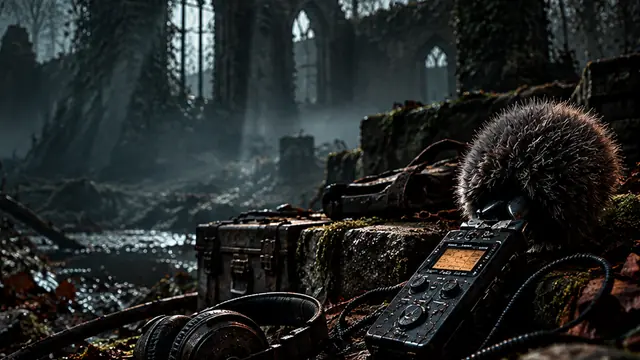
BBC Sound Effects
An online archive of over 30,000 BBC sound effects that can be searched, auditioned, mixed in a browser mixer and downloaded as MP3 or WAV.
Freesound
A free, collaborative online library of user-uploaded sounds (738,114 at the time of checking) run from the Universitat Pompeu Fabra, searchable by tag, with downloads requiring a free account.
Get the next guide by email
Get Richard's free horror sample pack, Flesh & Bow, by email.
Get the free sample pack →