
How to build horror atmosphere with reverb, echo and portamento
How I build horror atmosphere with reverb, echoes, portamento, my own voice and drones, plus a step-by-step track made with almost nothing but reverb.
By Richard Pryn ·
Okay, so what is atmosphere? It’s literally the tone or mood of a thing, whether that’s a place or a piece of work. In horror, the mood we set as composers sets the mood for the visuals. The picture has its own mood, sure, but the music can completely make or break it.
In the course I put the same footage of a dark woodland under different music, and even two different horror cues give you two very different woods. If you want to try that yourself, a set of night-time forest ambiences like Eerie Forest makes a good bed to write against.
So it’s never just a case of “I’ll chuck a drone on.” What drone? What space is it in?
Reverb: every space has its own atmosphere
Reverb imitates a space, so obviously it creates atmosphere. But every space has its own atmosphere, and that’s the important bit. It’s not “just chuck a reverb on, mate.” What reverb? What space? What vibe does it give the sound?
Try this. Play a simple horror interval on piano (a minor second is perfect) and run it through a few different reverbs:
- A long reverb, like a choir hall or a nine-second abbey. This is my go-to. The tail is so long it does a lot of the work for you and puts the listener in a new space.
- A small plate. Suddenly you’re in a confined space. Claustrophobic. Not obviously spooky, but it can be.
- Two reverbs at once. Bring a bright plate up alongside a massive reverb and the mood shifts again, sometimes classic horror, sometimes dreamy.
Then ask what the story is:
- A film set in an abandoned nuclear power plant, or a creepy little log cabin? Those want very different spaces.
- Trailer music? There’s a certain amount of epic, so I’d lean on the big, sustaining reverbs more than the small ones.
- Psychological horror? The space doesn’t have to be physical at all. You want it weird, introspective and freaky.
You don’t need expensive plugins. I almost always use Logic’s stock reverb because it does the job.
Echoes: wait, where am I?
Echoes imply a space too, and you can use that literally or metaphorically. A film about people going caving? Make it sound like a cave. A film about someone in a small terraced house in Manchester? Make that sound like a cave too. The jarring difference is what unnerves people.
What I’ve learned:
- Give the echoes a reference. A quiet pad or drone underneath gives them something to dance around.
- Interval matters. A minor chord with a minor second is classic. A plain minor chord isn’t quite so eerie.
- Don’t quantise. Human timing against a synced delay gives you a wonderful, unnatural hammering.
- Play to the sparseness. Play occasionally and let the echoes ring out.
- Push the feedback and the EQ. Longer feedback plus some EQ and the sound becomes unrecognisable. Almost like someone whispering.
- Use simple sources. Even finger snaps in a long echo make you think, wait, where am I?
Try different delay times (I ended up on a quarter note), then send the delays into a large reverb, not fully wet, for an extra tail. Echoes are brilliant little question marks, like someone knocking over a vase in the other room. It’s the musical equivalent of a dark, scary cave where you feel lost.
Portamento: slippery and unnatural
Portamento is a long, slow legato: you slide into the note instead of landing on it. Because the slide picks up every pitch in between, slowed right down it feels slippery and unnatural.
It’s not an outright scare. It’s the “this is weird and I don’t know why” feeling. The little girl at the window walks away, you turn back and she’s gone.
To try it:
- Load a string patch with portamento. Most libraries have one, and on a synth it’s called glide.
- Play slow chords. I like going from C minor to D flat minor over E: the C and D flat lead endlessly to and from each other.
- Layer it with a simple piano melody so the delayed slides pad it out.
- Keep it melodic or make it purely harmonic. Everything sliding in a bit late makes it feel even weirder.
No library? Grab any stringed instrument, or a box and an elastic band, sample it, load it into a sampler and glide between the notes nice and slowly.
Your voice: the signature nobody else has
Why is the voice so scary? Because when you hear someone’s voice and there’s nobody there, it’s terrifying. Disembodied voices, guttural noises, the death rattle, unnatural breathing.
Grab a mic and record all the weird stuff your mouth does: tongue smacks at the back of your throat, dry intakes of breath, the morning groan, clicks. None of them sound that weird in isolation. In a horror track, they really do.
- Lay a quiet drone as a bed.
- Chop out your best few sounds and normalise them. You don’t need many.
- Keep it loose. No ticking-clock pace here, just vibes.
- Put the breath in a large space, like a church. That long tail against the filthy close noises is a lovely juxtaposition.
That’s a horror intro right there. If you’re struggling for signature sounds, this is it. No one else has your voice.
Drones: a drone isn’t just a drone
A drone is dynamic. It’s texture, timbre and movement. Is it smooth and round, or spiky and erratic? High or low? A single note, or a full chord droning on underneath?
- Low drone: ominous, dark, scared.
- High drone: unsure, questioning, curious. It isn’t necessarily dark. Trailers often open on high strings for a sense of waiting. Add a few minor seconds and it tips towards bad.
Then think orchestration: texture (a round clarinet against a slightly spikier cello) and timbre (on a modelled synth, switch between steel, wood, glass and nylon and hear the mood change).
I mostly fall back on low drones with movement: automation, subtle pitch shifts, filter changes, or patches that move around the stereo field. A static low string drone gets boring fast. “Ooh, ominous. Okay, I get it.” If you want drones that already suggest a place, Doom Drones is organised into categories like cold halls, basements and tunnels.
A track from scratch using “only” reverb
Here’s how I built a short track where the spaces do almost all the work:
- Starting point. A simple horror interval on piano through a small plate and a big reverb. Bounce in place, transpose it down an octave, and that’s the foundation.
- Something wonky. Swap the big reverb for something weird that builds echoes. I played a C with a C sharp an octave higher, roughly every three bars but not exactly, because it’s eerier when you don’t know it’s coming. It hints at the character’s unstable mind.
- A distant whisper. Smaller reverbs on quiet intervals (C and G, D and F sharp, D flat and F), one panned left, one right. It sounds like it’s coming from a different space altogether.
- Something beefier. A tritone, C to F sharp, in a reverb that feels like the room next door. Repetitive, never resolving, transposed down a semitone so it feels even more off kilter, with pauses between phrases.
- A pad from a massive reverb. A cluster of B, C, D flat and D (B and C an octave apart in the left hand, D flat and D an octave apart in the right) through a huge reverb, bounced and pitched down a semitone. Then I duplicated it, shifted the copy up a semitone and reversed it, so the clusters jut against each other.
- The ending. Everything stops dead, like something has just died.
It’s only about a minute long, but it’s properly creepy. There are clusters and minor seconds in there, but in essence it’s an exploration of spaces. With no obvious tonal centre, it made me feel like I was slowly going mad. That was the idea.
Atmosphere is a set of choices: what space, what echo, how notes move, what your drone is made of. Make each one on purpose and the listener will feel it without knowing why.
Happy composing! Rich
Tools mentioned in this guide
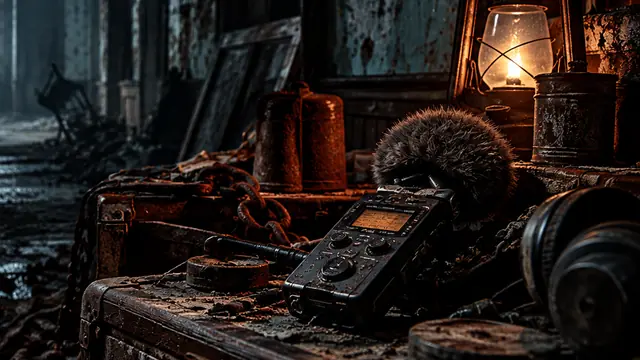
Doom Drones
A collection of 120 ambient drone loops (24-bit/96 kHz WAV, 3 GB), 60 by SoundMorph's Jason Cushing from field recordings and subtle tonal design and 60 by electronic musician Arovane using synthetic textures.
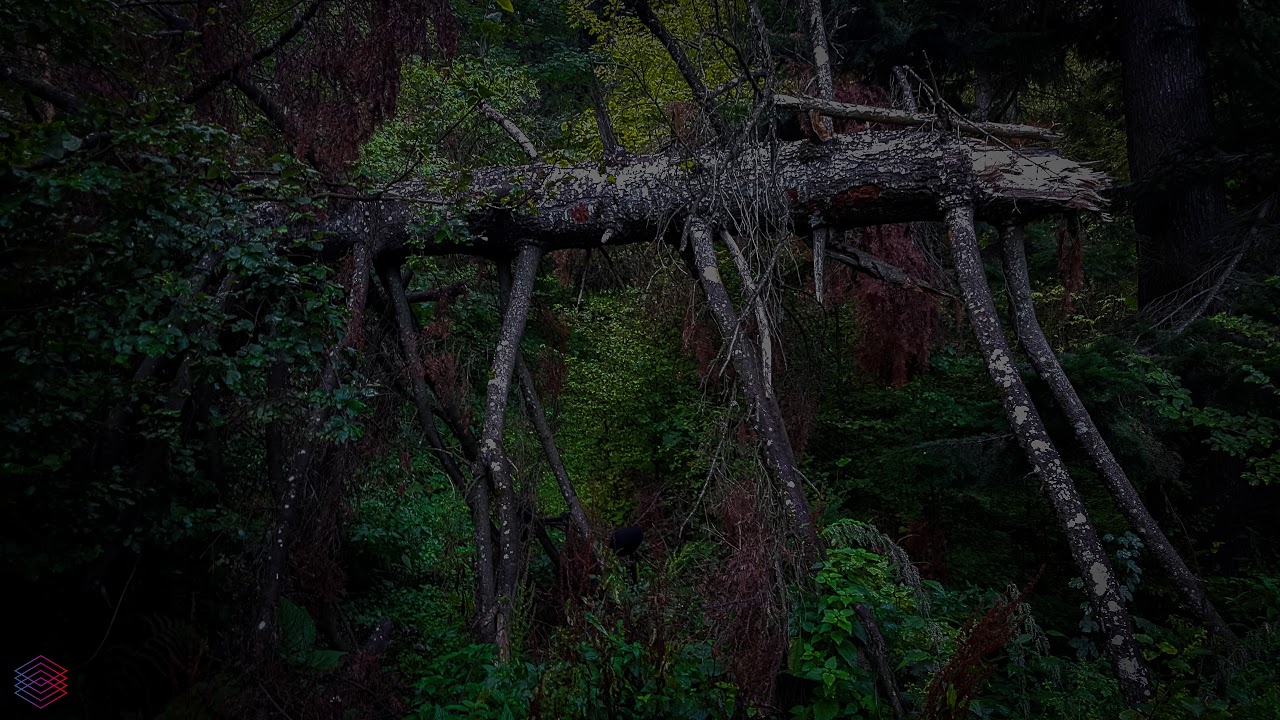
Eerie Forest
Thirty night-time forest ambiences (over 154 minutes, 24-bit/96 kHz WAV, stereo and surround) recorded in dense forests in Transylvania and Moldova, Romania, in 2017.
Get the next guide by email
Get Richard's free horror sample pack, Flesh & Bow, by email.
Get the free sample pack →